If your birth chart is the blueprint of your soul, astrology aspects are the key relationships and angles (measured in degrees) that connect your planets—revealing deep patterns and energies in astrology.
They show us how your inner world talks to itself — where there’s harmony, where there’s tension, and where the real growth lives.
Understanding birth chart aspects turns on the light in your astrology chart, helping you see the dynamics—harmony, tension, and growth—created by planetary aspects.
You don’t need to be an expert. You just need a guide (hi 👋), some visual help, and a few fun tools to make it click.
Psst! Want a deeper dive? Grab your free Self-Discovery Workbook: Start decoding your birth chart aspects now! This freebie includes prompts, printables, and cheat sheets to help you uncover your birth chart like a pro-with-a-candle collection.

What Are Astrology Aspects in a Birth Chart?
Let’s keep this simple (because we like easy wins around here).
Astrology aspects are the angular relationships between two planets (or calculated points) in your birth chart, aka natal chart. Think of them like energetic conversations — some are sweet and flowy (like a Sunday brunch), others are more… let’s say, constructive conflict over game night.
There are two main categories:
- Soft aspects in astrology (like the trine and sextile) are supportive, harmonious, and show where energy flows easily in your birth chart—often linked with talents and opportunities.
- Hard aspects (such as the square or opposition) in your astrology chart indicate tension and challenge, but can drive personal growth and transformation.
📝 How Aspects Shape Your Story
Your chart might show a chill Venus-Moon trine (emotional ease in relationships) or a spicy Mars-Pluto square (power struggles that teach you boundaries). Either way — aspects activate your planets. No activation = no story.
Grab This Free Birth Chart Workbook
Transform and Empower Yourself
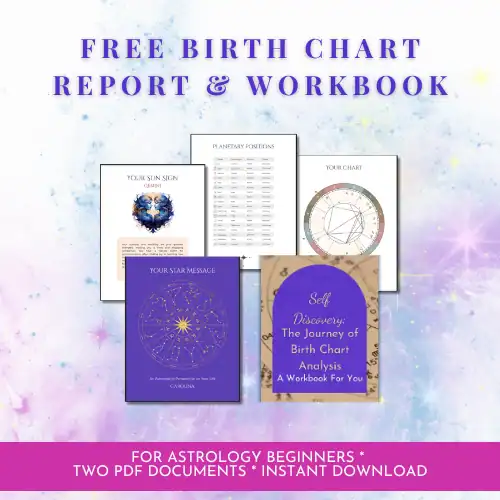
Grab my free personal birth chart report and self-discovery birth chart workbook with over 60+ pages to help you unveil the true you!
What’s Inside?
- Your Custom Birth Chart Report: A clear view of your natal wheel, a quick-reference placement layout, and an insightful breakdown of your Sun and Rising signs.
- 60-Page Self-Discovery Workbook: An immersive natal chart workbook to help you uncover your cosmic traits. Includes basic astrology cheat sheets, interpretation, and journal prompts.
Generate Your Birth Chart Report Now 👇
- Fill out the form with your accurate birth date, time, and location
- Wait a sec… and then!
- Download your report by clicking on the “Download” button.
- Save file to your device
- Watch your email inbox for a link to your workbook and a link to download the PDF again.

Astrology Aspect Symbols: What They Mean in Your Chart
Your birth chart kinda looks like a magical puzzle wheel. And the aspects? They’re the colored lines connecting planet to planet.
Astrology aspects are the specific angles created between two planets in your birth chart, measured in degrees.
Here’s your quick-start guide to the five major astrology aspects:
| Astrological Aspect | Symbol | Vibe |
|---|---|---|
| Conjunction | ☌ | Supercharged energy — two planets fuse into one bold statement |
| Sextile | ⚹ | Friendly flow — opportunities if you act on them |
| Square | □ | Inner friction — growth through challenge |
| Trine | △ | Natural talent — energy flows like warm honey |
| Opposition | ☍ | Polar opposites — tug-of-war that asks for balance |
🖨️ Want to explore your birth chart? Click here to download your Birth Chart Workbook filled with cheat sheets — perfect for taping into your journal, planner, or next new moon ritual setup.
Major Astrology Aspects Explained (Conjunction, Trine, Square, Sextile, Opposition)
The five major aspects are the backbone of astrological interpretation. They’re the ones that show up first in any chart reading and shape the dominant dynamics of your personality and life path.
- Conjunction (0°): Two planets, same place. Unified energy—can be intense. Think amplified qualities or merged instincts. It can feel powerful, but sometimes too much.
- Sextile (60°): Friendly support. Opportunities if you act on them. These aspects feel easy, like helpful nudges from the universe—but they still require you to participate.
- Square (90°): Tension. Challenge. Pushes growth. Squares bring friction, yes, but also transformation. They’re like resistance training for the soul.
- Trine (120°): Natural flow. Easy talents. Trines can show where things just click—but watch for complacency. Sometimes what’s easy is also what’s ignored.
- Opposition (180°): Polarity. Balance needed. Oppositions highlight extremes and call you to integrate opposites. They’re mirrors—often in relationships.
Each astrology aspect in your birth chart has its own meaning—what matters is the dynamic between the planets involved and the degree of the aspect (known as the orb).

Major vs. Minor Aspects in Astrology: What’s the Difference?
While major aspects dominate most interpretations, minor aspects add nuance. Think of them as seasoning—not essential to the structure, but helpful in crafting a more complex picture. They can explain subtleties in your behavior, creativity, or blocks that don’t quite make sense at first glance.
They’re also often where you find hidden gifts or low-key challenges that don’t grab attention right away but affect the bigger picture.
- Quincunx (150°): Misunderstanding. Planets don’t get each other. Adjustment required.
- Semi-sextile (30°): Subtle connections. Could indicate slight compatibility or gentle nudges.
- Quintile (72°): Creativity or quirky genius. Often shows up in artists, inventors, and rule-breakers.
Start with majors. They give you the clearest picture. But when you’re ready, exploring minor aspects can help explain the little contradictions and unexpected gifts in your chart.

How to Find and Read Aspects in Your Birth Chart (Step-by-Step Tutorial)
This is where things get fun — like solving a cosmic Sudoku puzzle. Don’t worry, you don’t need to be a math whiz or a mystic-in-residence to figure it out.
👉 Need a simple how to read a birth chart tutorial?
Step 1: Start With Your Birth Chart
Grab your free birth chart with me, see above. Plug in your birth date, time, and place. Voilà — your natal chart is born. Print it out, or hold it in your hand to reference easily.
Step 2: Look at the Web of Lines
Inside the wheel, you’ll see a criss-cross of colorful lines. These are aspect lines, connecting planets that “see” each other in the sky.
Step 3: Decode the Symbols
Look along the chart’s edge or the aspect table (usually below the chart). You’ll spot astrology aspect symbols like ☌ (conjunction), △ (trine), and ⚹ (sextile). These symbols reveal the specific aspects between planets in your birth chart.
–> Some charts use red lines for oppositions and squares. Blue or green lines for trines and sextiles.
Step 4: Check the Degrees Between Planets
Every aspect is formed at specific angles, aka degrees. For example:
- Trine = ~120°
- Square = ~90°
- Opposition = ~180°
Not every close degree counts, though — that’s where “orbs” come in (hang tight, we’re almost there).
here’s a hint… Zodiac signs that share an element are naturally in a trine with each other, and signs that share a modality are naturally in a square or opposition with each other. Learn the elements! and modalities and you’ll quickly understand astrological aspects.
📸 Want a visual? Try screenshotting your chart and circling one aspect you want to explore. Then grab your cheat sheet and match the symbols — it’s like astrological Mad Libs, but more enlightening.
Aspect Orbs in Astrology: Degree Ranges for Aspects Simplified
Let’s demystify a term that trips up a lot of newbies: orbs.
An “orb” is the wiggle room between two planets. If they’re almost the right number of degrees apart, they might still “count” as forming an aspect — depending on how wide the allowed orb is.
Here’s a quick reference for aspect orbs in astrology (the degree ranges that count for each aspect):
| Aspect | Degrees (Orb) |
|---|---|
| Conjunction | 0–7° (depending on the planetary bodies involved) |
| Sextile | 0–6° |
| Square | 0–8° |
| Trine | 0–8° |
| Opposition | 0–8° |
🎯 Pro Tip: The tighter the orb, the stronger the influence. A Moon-Mars square at 1°? Loud. That same square at 7°? Still active, just subtler — like background music instead of a drum solo.
Not sure how close your planets are? Easy math! Just count the degrees (numbers) between one point and the other. There’s only 30 degrees total when counting.
Ex: Sun at 8 degrees and Moon at 12 degrees… they’re four degrees apart. 12 – 8 = 4.
How Aspect Meanings Change by Planet and House
Let’s add some flavor to the astro stew. Because not every square, trine, or conjunction hits the same.
An aspect’s vibe shifts depending on:
- The planets involved (Venus and Saturn = different story than Mars and Uranus)
- The astrological houses they live in
- Your unique chart energy
Example Flavors:
- Sun conjunct Mercury = Mental sparkle. You process life through thoughts and words.
- Mars conjunct Uranus = Electric drive. Fast, bold, unpredictable action.
- Venus square Saturn = Lessons in love. Boundaries meet desire.
- Moon trine Jupiter = Emotional generosity. Feels like warm cookies and a pep talk.
This is where birth chart reading becomes art — not just numbers and symbols. The same aspect can play out wildly differently depending on your chart’s overall vibe.
🧩 Think of it like this: Aspects are puzzle pieces — but the full picture only appears once you step back and see how they all connect.

Astrology Tools & Resources
Here’s your astro go-bag — everything you need to start reading aspects today:
🔗 Free Chart Calculator:
📕 Download Your Free Self-Discovery Workbook
Full of printable cheat sheets, journal prompts, and space to decode your own chart.
🗓️ Track Transits with an Astrology Calendar:
Follow how current planetary aspects affect you. (Time Nomad is a fave app!)
📝 Keep an astrology journal with these 33 ideas and prompts.
🌙 Join the Cosmic Wealth Collective
The place to build income with astrology-powered guidance for your business and money moves.
Quick-Start Guide: How to Interpret Aspect Lines in Your Birth Chart
Got 60 seconds? Let’s find one aspect in your chart — right now.
- Open your chart.
- Look for the aspect table or the colored lines.
- Spot one symbol (like ☌ or △).
- Check the two planets it’s connecting.
- Match the symbol to your cheat sheet and jot down your interpretation.
Now flip to your Self-Discovery Workbook and journal:
What does this aspect say about how you express emotion? Communicate? Love? React?
That’s the magic. You’re not just learning astrology, you’re learning you.
Join Us Inside Skool: Where Cosmic Alignment Meets Real Strategy
Free to join. Woo-Led. Heart-Centerd Focused.
Loved this blog post? We take these concepts much deeper every single week inside our Skool community!
Whether you’re just launching or scaling your business, you’ll get access to weekly coworking sessions, digital marketing resources, and a supportive network of entrepreneurs who get the woo and the strategy.
Next Steps for Self-Discovery
This is just the beginning, dear cosmic traveler. Your birth chart is a cosmic map — and aspects are the compass.
Keep exploring:
- Dive deeper into your chart with your workbook
- Share your money goals in the Cosmic Wealth Collective — ask questions, get support
- Bookmark this post so you can come back any time things get fuzzy
Got a chart you’re working on? Drop your top aspect in the comments — I’ll help you decode it!
IF THIS POST HELPED YOU IN ANY WAY, Please Pin To Your Woo Boards!
It helps my blog tremendously. Thank you!